I once had to cancel a dinner date because of a speck of white tissue no bigger than a grain of rice. It sounds ridiculous, doesn’t it? But if you have ever had a canker sore, you know that tiny ulcer feels like a glowing ember pressed against your cheek. I spent years thinking I just had to ‘tough it out’ or, even worse, I would douse it in harsh chemicals thinking I was cauterizing the wound. I was wrong. I remember one specific night where I was so desperate for relief I tried a homemade concoction that basically felt like I was gargling liquid fire. My mistake was thinking that pain equaled healing. I did not realize that I was actually stripping away my mouth’s natural defenses, much like why your mouth stings when you use alcohol-based mouthwash. Today, I want to share the exact steps I use to shut down that stinging sensation instantly so you can get back to enjoying your morning coffee without a wince.
Stop the Fire in Your Mouth Right Now
Dealing with a canker sore is less about ‘curing’ it—since your body does that on its own—and more about creating a protective barrier so you can function. When that raw nerve ending is exposed to air, saliva, or salt, it screams. I have learned that a solid oral health routine is your best defense, but when you are already in the middle of a flare-up, you need a tactical plan. Most people reach for the wrong things first. They want to scrub it or ‘clean’ it with things that are way too aggressive. I used to be the king of over-brushing until I realized that why hard brushing actually makes your teeth look darker and can also irritate the delicate tissues where canker sores love to hide. Have you ever tried a home remedy that made the pain ten times worse? Tell me I am not the only one who has made that mistake!
Is those viral ‘salt-on-the-wound’ hacks actually worth the hype?
Absolutely not. Please, for the sake of your sanity, stop putting straight salt on a canker sore. While salt water rinses are great for changing the pH of your mouth, direct salt application is just unnecessary torture. According to the Mayo Clinic, canker sores (aphthous ulcers) are not the same as cold sores and are not contagious, but they are often triggered by stress or minor injuries to the inside of the mouth. If you are constantly battling these, it might be time to look at some updated oral health tips to see if your toothpaste or diet is the hidden culprit. In the next section, I am going to show you the ‘Dry-and-Dab’ method that actually stays on the sore instead of washing away in two seconds.
Why Drying the Wound is the Only Way to Make Treatments Stick
Imagine trying to paint a fence while a high-pressure sprinkler is hitting it. That is exactly what happens when you try to apply a gel or cream to a canker sore without preparation. Your saliva is the ultimate protector of your teeth—in fact, why your saliva is your best defense against decay is a fascinating topic—but in this specific scenario, it acts as a lubricant that slides your expensive medicine right down your throat before it can do its job. To get actual relief, you have to create a temporary ‘dry zone’ inside your mouth. This is the foundation of the core technique I use whenever a flare-up threatens to ruin my week.
Set Up a Clean and Dry Treatment Zone
First, grab a clean cotton swab. You need to gently pat the ulcer and the surrounding area until the skin looks matte rather than shiny. This is crucial because most over-the-counter numbing agents or protective films are hydrophobic; they hate water. If the site is wet, the medicine just clumps up. When I first started doing this, I realized that my previous failures weren’t because the medicine was bad, but because my application was sloppy. This level of precision is similar to how a professional prepares a tooth for a procedure to ensure the impact of regular teeth cleaning on overall oral wellness stays consistent. Once you have that dry surface, you have about five seconds before your salivary glands realize what’s happening and try to flood the zone again.
Create a Liquid Bandage to Lock Out Irritants
Now, apply your chosen treatment—whether it is a specialized benzocaine gel or a simple dab of milk of magnesia—directly to the dry center of the sore. The goal is to create a ‘physical bandage.’ I like to hold my lip away from my teeth for at least sixty seconds to let the treatment air-dry and set. If you let your lip snap back immediately, the medicine just smudges onto your teeth. Think of this like a temporary seal. While you are focusing on this local pain, don’t ignore other signals; sometimes what feels like a canker sore near the gumline is actually a sign of something else, so knowing how to tell if your tooth sensitivity is a cavity can save you a lot of guesswork. 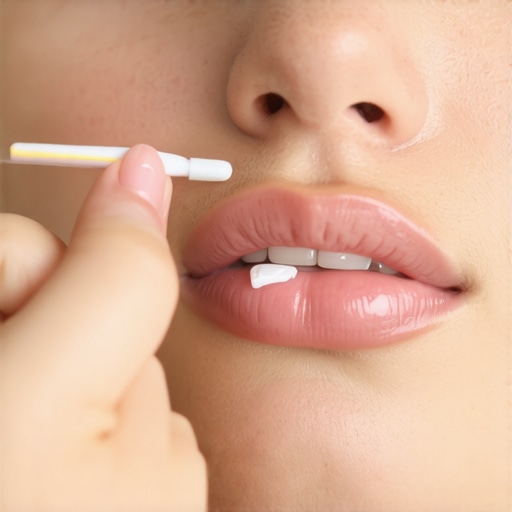
Ditch the Ingredients That Are Poisoning Your Progress
While you are in the healing phase, your diet and your bathroom cabinet need a temporary overhaul. Anything acidic, like citrus or soda, will melt that protective barrier you just worked so hard to create. If you have children, you already know that the best snacks for kids that won’t cause cavities usually involve low-acid, non-abrasive options; follow that same logic for yourself. Furthermore, check your toothpaste for Sodium Lauryl Sulfate (SLS). This foaming agent is a known irritant for many people and can actually make the ulcer last twice as long. Switch to a sensitive, SLS-free version as part of your temporary oral health routine strengthening your smile every day.
The Wedding Toast That Almost Didn’t Happen
I remember my sister’s wedding in 2019 where a massive ulcer on my lower lip made even smiling for photos feel like I was being poked with a hot needle. I had to give the Best Man speech, and I was terrified I would stumble over my words because of the sharp stings. I locked myself in the venue’s bathroom five minutes before my name was called and used the ‘Dry-and-Dab’ method with a thick layer of protective paste. I looked a bit ridiculous standing there with my lip pulled out for a full minute, but it worked. I got through the entire ten-minute speech with zero pain. The trick wasn’t the brand of medicine I used; it was the fact that I didn’t let my saliva wash it away. You have to be aggressive about protection. If you are too rough with your mouth in general, remember why hard brushing actually makes your teeth look darker and realize that a gentle touch is always more effective for long-term health.It is funny how we are taught the basics of hygiene as kids, but we rarely get the ‘Pro’ update as adults. For example, most people think that a vigorous rinse after brushing is the final step to a clean mouth. I used to do this religiously, thinking I was washing away the debris. But here is the contrarian truth: if you rinse with water immediately after brushing, you are essentially undoing all the work you just did. You are washing away the concentrated fluoride that needs time to bond with your enamel. The British Dental Association actually recommends that you ‘spit, don’t rinse’ to keep that protective layer intact. This is one of those teeth cleaning secrets effective home practices for family dental health that most people ignore because it feels ‘messy.’ Then there is the issue of dental crowns. I see people treat them like they are made of indestructible diamond. They think because the tooth is ‘covered,’ it is safe from decay. This is a massive ‘oops’ factor that leads to thousands of dollars in repairs. Bacteria don’t care about the porcelain; they care about the tiny margin where the crown meets your gum. If you don’t clean that seam, you will end up wondering how to stop your crown from smelling like old food. That smell isn’t just trapped lunch; it is often the scent of active decay beneath the restoration.
Why do my gums still bleed even when I floss every single night?
This is a question I get from the most dedicated patients. They feel like they are failing, but the nuance is often in the technique, not the frequency. If you are just ‘snapping’ the floss between the teeth, you are likely missing the subgingival pocket. You need to ‘C-wrap’ the floss around the tooth to reach the area where the truth about why your gums bleed only when you floss becomes clear: it is usually localized inflammation from a missed spot, not a sign to stop flossing. Another advanced mistake is ignoring the ‘fuzzy’ feeling on your teeth at midday. That is biofilm, and if it is not addressed, it hardens into tartar that only a professional can remove. Realizing the impact of regular teeth cleaning on overall oral wellness means understanding that your home care is just half the battle. We also need to talk about expert advice on crowns and teeth cleaning for lasting results because the way you brush a crown should be different from how you brush a natural molar. Have you ever fallen into the trap of thinking your dental work was ‘set it and forget it’? Let me know in the comments—I’ve definitely been there!If you’re anything like me, you’ve stood in the pharmacy aisle staring at a wall of $200 toothbrushes wondering if they actually do anything more than a $5 manual one. I finally bit the bullet three years ago after a particularly expensive cavity filling. I chose a sonic brush with a built-in pressure sensor, and it was a total game-changer. Why? Because most of us are ‘scrubbers’ by nature, often pushing too hard and damaging the very tissue we are trying to save. The technical reality, as highlighted in a Cochrane Database of Systematic Reviews study, shows that powered toothbrushes—specifically those with oscillating-rotating technology—reduce plaque by 11% and gingivitis by 6% more than manual brushing after just one month of use. This isn’t just marketing fluff; it’s about the sheer frequency of strokes that no human hand can replicate, making it an essential part of an oral health routine strengthening your smile every day.
Stop Guessing and Start Measuring with the Right Gear
When it comes to crowns, the gear matters even more. You need to be surgical in your approach. I’ve started using interdental brushes instead of just relying on standard string floss. If you have a bridge or a tight crown, the proper way to use interdental brushes for best results involves choosing the right size so the wire doesn’t scratch the porcelain or irritate the gum line. This is a core part of caring for crowns essential tips for longevity and shine. I also keep a water flosser on my counter, but I treat it like a ‘pre-wash’ for the heavy lifting. It’s great for dislodging the big stuff, but it won’t replace the mechanical scraping needed to disrupt biofilm. #IMAGE_PLACE_HOLDER_D#
Why Your Water Flosser Needs a Partner
Many people think the water flosser is a ‘get out of jail free’ card for flossing. It’s not. Think of it like a power washer for your car; it gets the mud off, but you still need a sponge to get the microscopic film off. Using both together is how you truly see the impact of regular teeth cleaning on overall oral wellness. I personally use the water flosser first to clear the path, then follow up with the interdental brush to polish the surfaces between my molars.
How do I maintain my dental crowns for the long haul?
Maintenance isn’t a weekly chore; it’s a daily commitment to the ‘margins.’ The margin is that tiny line where the crown meets your natural tooth, and it is the crown’s Achilles’ heel. I follow maintaining your dental crowns dos and donts for best results by using a non-abrasive gel rather than a gritty whitening toothpaste, which can actually wear down the porcelain glaze over time. If you’re managing a whole household, focusing on family dentistry focus building a lifetime of healthy smiles means teaching your kids that the tools we use are just as important as the time we spend.
The Future of Brushing Might Be Smarter Than Your Phone
Looking ahead, I suspect we are moving toward ‘Smart Dentistry’ where your toothbrush will analyze your saliva in real-time for biomarkers. Imagine your brush sending a notification to your phone saying you need more Vitamin C or that a specific molar is showing early signs of demineralization. Until then, we have to rely on expert advice on crowns and teeth cleaning for lasting results. My best advice for right now? Buy a high-quality electric brush today and try the ‘no-rinse’ rule for just one week. You will notice your teeth feel smoother for longer. It’s the easiest and cheapest ‘upgrade’ you’ll ever give your smile.
Hard Truths About Oral Health I Learned the Expensive Way
Looking back at my history of dental drama, the most important realization was that my mouth isn’t an island; everything is connected. First, I had to accept that pain is rarely a sign of cleaning; usually, it’s a sign of aggression. When I stopped trying to ‘scour’ my gums, they finally stopped bleeding. Second, the ‘Dry-and-Dab’ technique for canker sores taught me that dental care requires a bit of strategy, not just a blind application of medicine. Third, I discovered that consistency beats intensity every single time. A gentle oral health routine strengthening your smile every day is worth more than a desperate hour of scrubbing once a month.
The Daily Toolkit for a Resilient Smile
I’ve tested hundreds of products, and these are the four I keep within arm’s reach. First, a sonic toothbrush with a pressure sensor is non-negotiable if you want to avoid recession. Second, if you struggle with gaps, knowing how to clean between teeth if you have tight spacing becomes much easier with waxed silk floss or a dedicated water flosser. Third, for those with restorations, following maintaining your dental crowns dos and donts for best results is the only way to avoid that lingering odor or underlying decay. Finally, interdental brushes are the unsung heroes of the bathroom cabinet; when you master the proper way to use interdental brushes for best results, your dental hygienist will notice the difference within minutes.
#IMAGE_PLACEHOLDER_E#
Your Future Smile Starts with These Small Changes
Improving your dental health doesn’t mean you need to spend thousands of dollars overnight. It starts with the tiny habits, like remembering why you should stop rinsing with water immediately after brushing or finally ditching that harsh, alcohol-based mouthwash that strips your mouth’s natural moisture. You deserve to eat, speak, and smile without thinking about pain or sensitivity. By taking control of your daily habits, you are investing in a lifetime of confidence. Let’s make those teeth cleaning secrets effective home practices for family dental health a permanent part of your life. Have you ever tried the ‘no-rinse’ method after brushing, or did it feel too strange to leave the toothpaste on? Let me know in the comments below!